© 2026 Rentokil Initial plc is subject to Dutch law. All rights reserved. Legal notice.
From cultivation to compost
At Ambius, circular material management sits at the core of our service delivery. From the deliberate cultivation management of our foliage to the re-use of structural materials, and from restoring return plants to processing organic matter responsibly once visual appeal has faded. We prioritize circular applications that maximize resource efficiency and minimize material waste, supporting responsible office environments through well-engineered resource management.
Closing the loop
Our operational approach follows a 9-step framework designed to ensure circular, responsible decision-making across all service touchpoints:
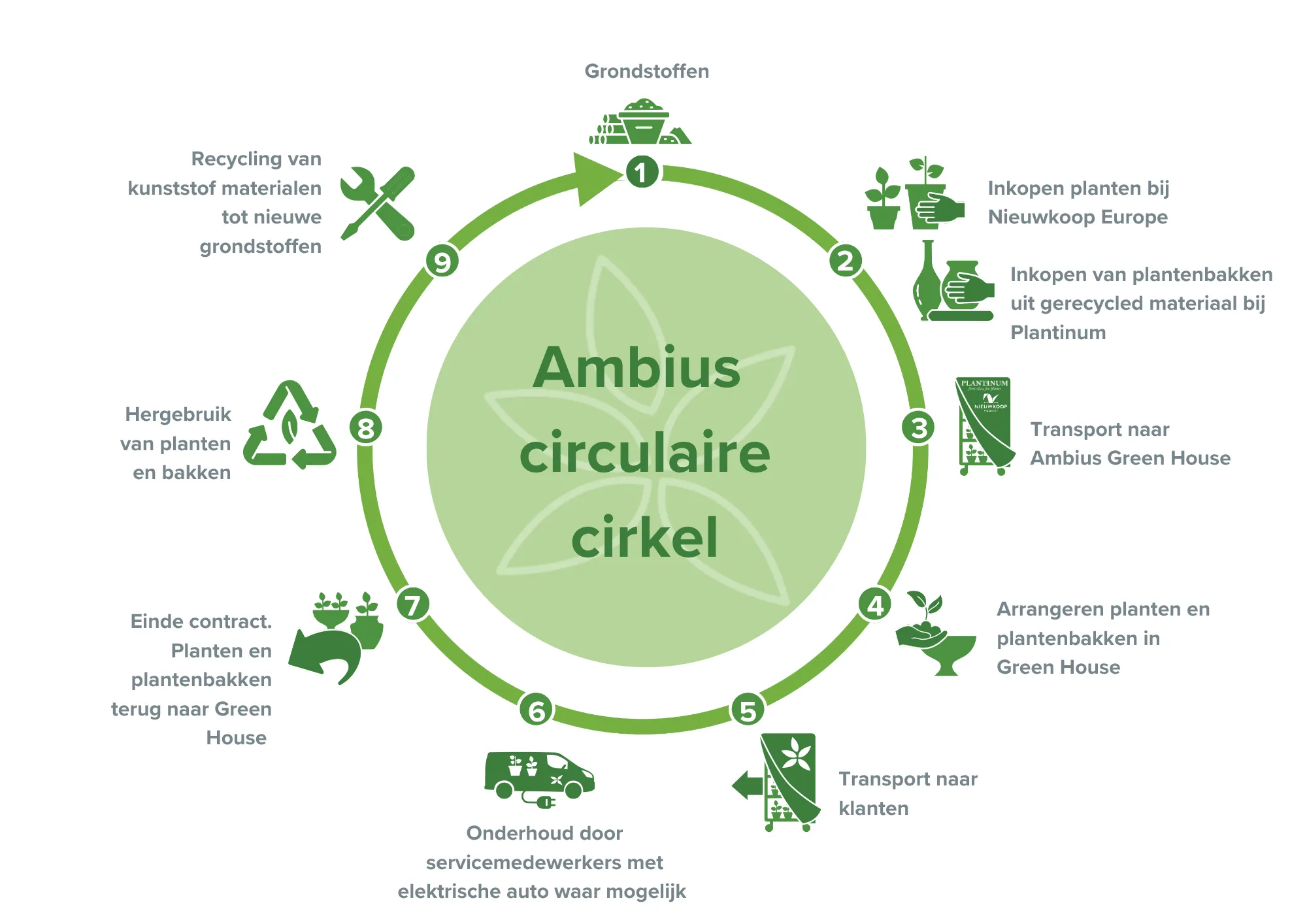
Step 1: We assume chain responsibility by continuously integrating circular practices in close collaboration with our suppliers, limiting the consumption of virgin raw materials.
Step 2: We guide clients toward long-lifecycle planters. For bespoke projects, we partner with manufacturers utilizing high-grade recycled polystyrene. Our plants are sourced from specialized nurseries, such as Nieuwkoop, that adhere to certified and audited cultivation practices.
Step 3 & 4: Every quarter, we collaborate with our suppliers to advance re-use initiatives. In an active pilot program, we test transit workflows that eliminate single-use plastics, styrofoam, and cardboard, substituting them with reusable covers, crates, roll containers, and protective sleeves to reduce packaging waste.
Step 5: We have largely replaced single-use packaging with heavy-duty reusable protective covers. This eliminates plastic wrapping during transport, achieving a 68% reduction in single-use packaging materials.
Step 6: Our service technicians utilize electric vehicles for low-emission local transport. Our certified specialists maintain plants regularly to extend their lifespan and safeguard quality. We utilize biodegradable plant food and ecologically responsible crop protection formulations, such as Spruzit-R and Promanal-R concentrate.
Step 7: Plants no longer meeting Grade-A visual standards are transferred to our Greenhouse in Duiven, where they are nurtured for redeployment. High-value return plants are rejuvenated in our dedicated facility. Featuring a closed-loop water recovery system that filters and recirculates harvested water, we manage irrigation responsibly.
Step 8: Direct re-use is prioritized over recycling (aligned with Lansink's R-ladder). We systematically re-use hydrogranules, water meters, and culture pots. Suitable return plants receive a second life through our Green Return program. Plants that have fully lost their ornamental value are processed into high-grade biomass for composting or green gas production.
Step 9: Recycling is initiated only when re-use is no longer feasible. Retired hydrogranules are repurposed into road construction applications via De Putman Groep. Non-reusable planters are compacted in our Greenhouse to optimize transport volume, after which manufacturers grind them into granulate to produce new, fully recyclable containers from recycled polystyrene.
Circular material use
Ambius merges biophilic design innovation with conscious material choices. Our international research team continuously refines our portfolio to reduce reliance on primary raw materials. For example, we repurpose reclaimed scaffolding timber into fixed on-site planters and offer a circular green furniture collection finished with water-based lacquers. Local production in Germany (30 km across the border) ensures rapid delivery and shorter transport distances compared to intercontinental import.
Re-using office materials
As part of the Greene concept for ABN AMRO Netherlands, Ambius converted retired printer cabinets into bespoke office planters. This circular solution is deployed across 4 head office locations and 40 regional branches, creatively repurposing existing office assets.
Energy-efficient festive decorations
For Christmas trees and holiday decor, Ambius selects energy-efficient, reusable options, including warm LED lighting systems and automated timer switches. We continually evaluate emerging alternatives based on measurable impact, enabling clients to choose responsible festive displays.
Spatial comfort and experiential value with plants
For Ambius, corporate social responsibility extends beyond raw materials to encompass the creation of inspiring, comfortable workplaces. By combining biophilic design principles with interior landscaping, we integrate nature into the built environment. This supports indoor climate quality, spatial balance, and a positive atmospheric effect on workplace satisfaction.
Ambius in your region
More information and inspiration
We make targeted choices in materials, production, and transport to gradually reduce the environmental impact of our operations.
Have a question or want to explore the options for your space? Our specialists are happy to share their expertise with you.
We transform business spaces with interior landscaping, scenting, moss designs, and Christmas decorations. Discover who we are and what we can do for your organization.